Hands, feet and faces, simplified
You'll learn to suggest hands, feet and faces with simple shapes so they support your figures instead of slowing them down.
15 min
Hands, feet and faces scare a lot of people. They're complicated, everyone knows exactly what they look like, and every mistake seems to jump out. In urban sketching you can breathe out: a figure four centimetres tall doesn't need fingernails or eyelashes. It needs the right size, the right direction and a believable posture. Simple shapes are all it takes.
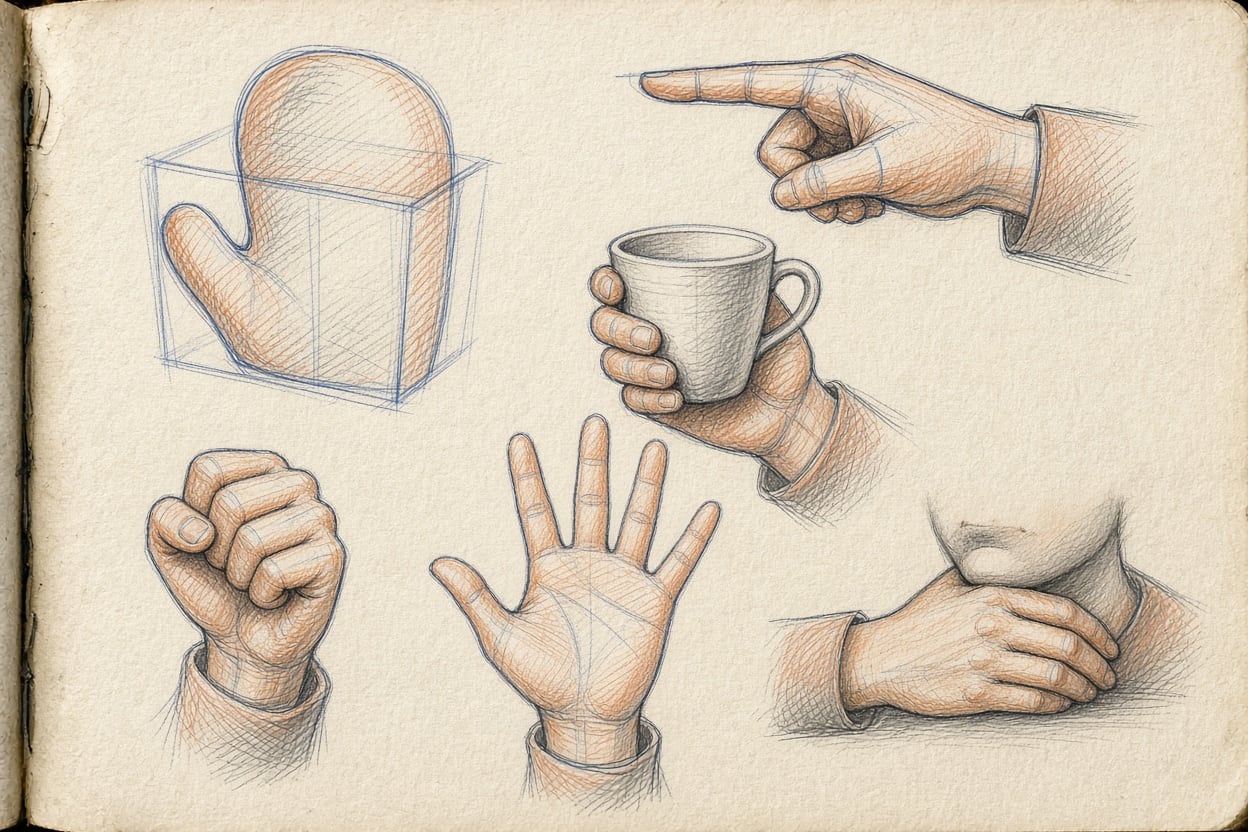
The hand as a mitten
Think of the hand as a mitten: one flat, slightly rounded shape for the palm and fingers together, with a separate wedge for the thumb. The thumb doesn't sprout from the side of the fingers; it starts lower down, almost at the wrist, and points diagonally forward. Get that right and even a plain mitten outline reads as a hand.
As for size, a hand is about as long as the face from chin to hairline. Many people draw hands far too small, which makes the figure look weak or childlike. Better slightly too big than too small.
If someone is holding something, a cup, a phone, a strap on the bus, draw the object first and let the mitten shape wrap around it. The hand explains itself through what it's doing. If a hand hangs loose, a short tapering stroke at the end of the forearm is often enough.
The foot as a wedge
Seen from the side, the foot is a wedge: high at the back by the heel and ankle, flat at the front by the toes. From the front it's heavily foreshortened, almost a triangle or a small trapezoid. A foot is about as long as the forearm from elbow to wrist, which also surprises many people.
Direction matters more than shape. The feet show where someone is going or looking, and they connect the figure to the ground. Draw the standing foot flat on the ground and the free foot perhaps only on its toes. In shoes, the wedge is often even clearer.
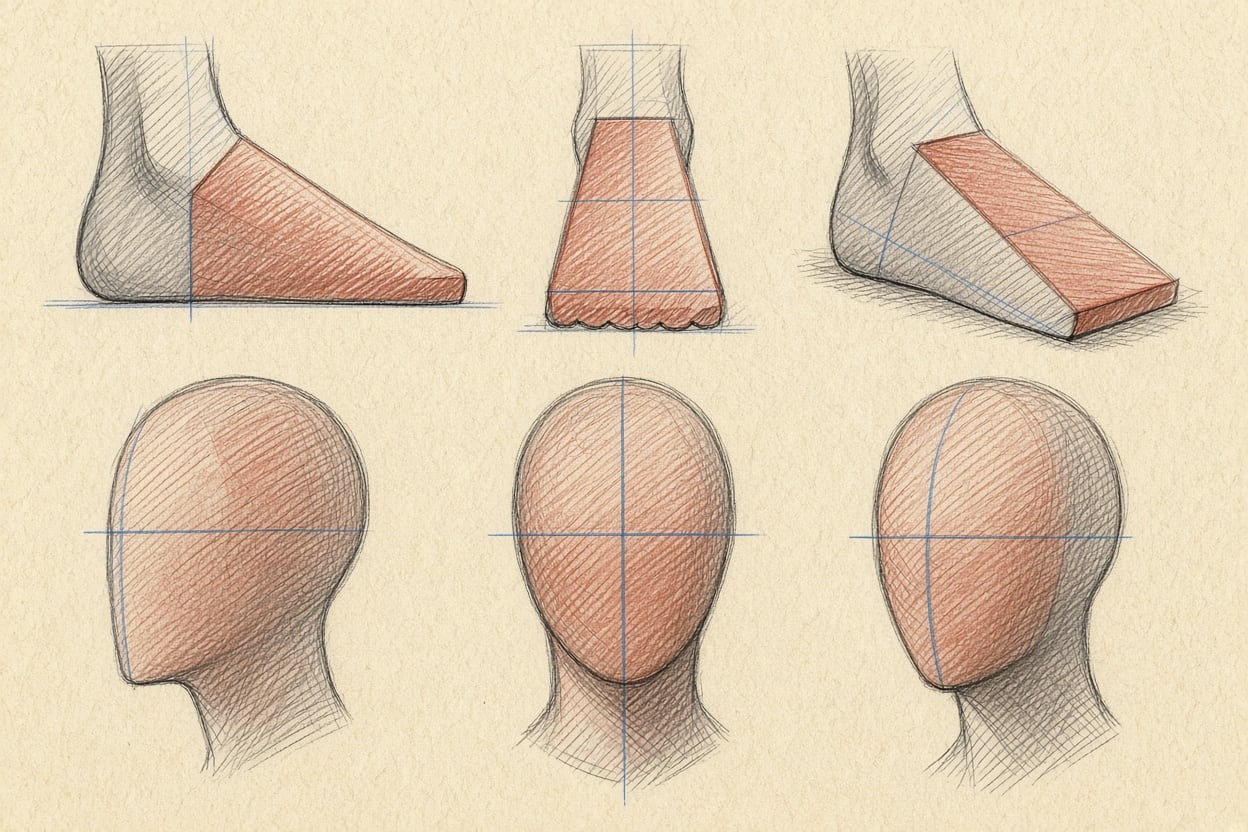
The face as a cross
For the head, take the oval from the stick figure and draw a cross on it. The vertical line is the centre line of the face and shows where the person is looking. If someone turns their head to the left, the centre line moves left and curves with the shape of the head.
The horizontal line is the eye line, and it sits roughly halfway down the head, measured from crown to chin. That's lower than most people expect, because we tend to underestimate hair and forehead. If someone tilts their head down, over a book for example, the eye line drops and curves downward. If they look up, it curves upward.
With this cross alone you can show the direction of gaze and the angle of the head without drawing a single eye.
Less is more
In urban sketching you usually leave faces without features. A person crossing the square ten metres away doesn't have recognisable eyes to your own eye either. Draw them in anyway and the figure jumps out of the picture and turns stiff. An oval, perhaps with the shape of the hair and a hint of the cross for direction, is enough. On nearby figures you might add a shadow under the nose and chin; you rarely need more.
Posture matters more than detail. A well-judged tilt of the head, an arm holding a bag, a foot meeting the ground tell you more about a person than a carefully drawn eye.
Exercise
Sit in a café, on the tram or on a bench, or use photos of people going about their day. First fill a page with practice shapes: ten hands as mittens with thumbs in different positions, ten feet as wedges from the side and front, and ten heads as ovals with crosses facing different ways. That takes about 9 minutes. In the remaining 6 minutes, draw two complete figures where it's clear what the hands are doing and where the head is facing, with no facial features at all. Photograph both and show them to the coach.