People in motion, fast
You'll learn to capture walking people in a few seconds, to place every head correctly at eye level, and to draw from memory.
20 min
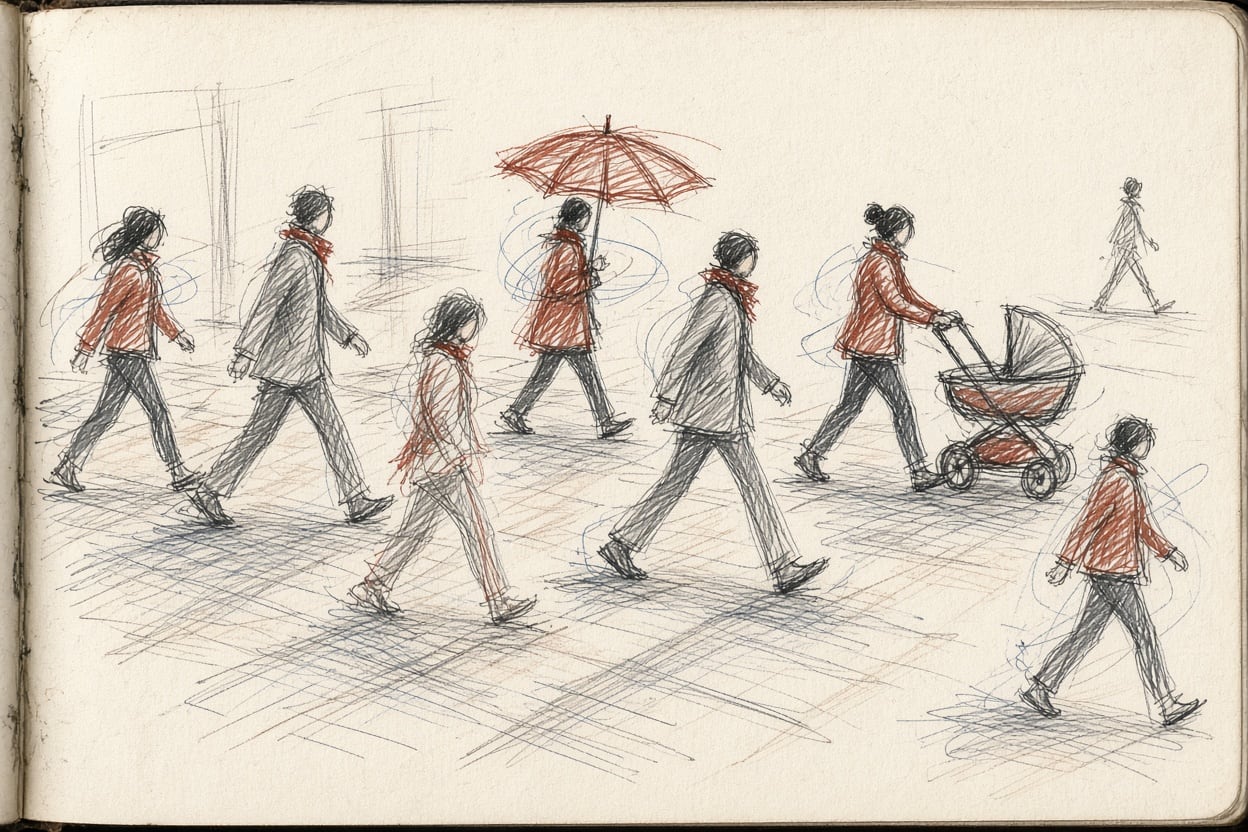
Most of the people you see in a city are on the move. They cross the square, step off the tram, hurry for a train. If you wait for someone to stand still, your sketchbook stays empty or fills up with people queuing. In this lesson you'll learn to catch movement, and for that you need to be quicker than your doubts.
What walking looks like
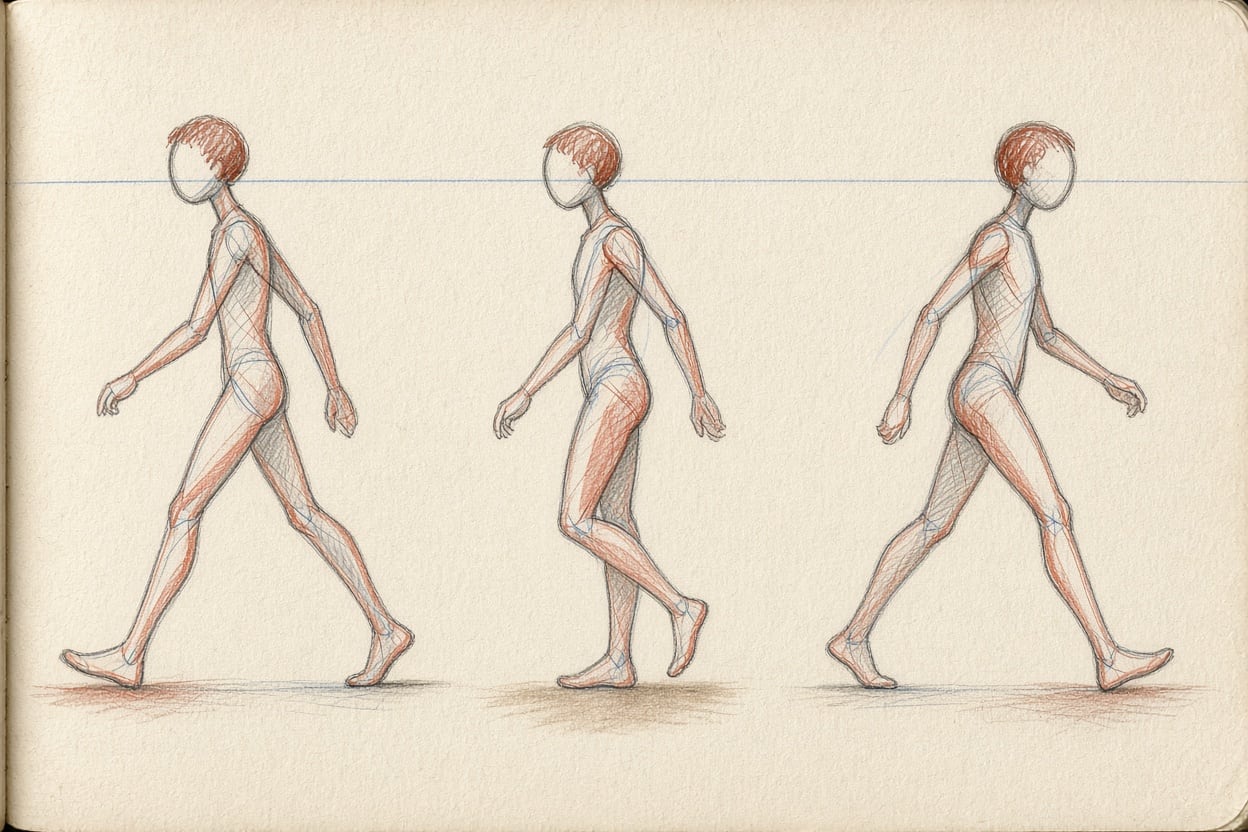
Walking alternates between two moments. In the first, both feet are on the ground, far apart: the front leg lands on the heel, the back leg pushes off with the toes. In the second, one leg carries all the weight while the other swings past it, bent. The first moment works best for sketching, because the legs form a clear upside-down V and the movement reads instantly.
The arms swing opposite to the legs. If the left leg is forward, the right arm is forward. That sounds obvious, yet plenty of people, on their first try, draw the arm and leg on the same side moving forward together. The figure then looks like a robot. Check it on yourself next time you go for a walk.
When walking, the upper body leans slightly forward, more so when in a hurry. Someone strolling walks upright, often with hands in pockets. Someone running throws themselves into the movement.
Every head at eye level
Here's a rule that saves you a lot of work. If you're standing on level ground and drawing people roughly your own height, their heads all sit at about your eye level, which is the horizon line. That holds for the person two metres away just as much as for the one a hundred metres off. Only the feet move: the further away someone is, the higher their feet sit in the picture, and the smaller the figure becomes.
So start by lightly drawing a horizon line. Then put each head on it and hang the body downwards. Children and shorter people won't quite reach it, taller people poke above it slightly. If you're sitting down, your eye level drops, and the line cuts standing people at roughly chest or hip height. The principle stays the same: the line crosses every figure at the same point on the body.
Five seconds, thirty seconds
Practise at two speeds. The 5-second sketch is almost pure gesture: a dot for the head, a line for the back, two strokes for the legs mid-stride, perhaps one for a swinging arm. It shows direction and pace, nothing else. Do twenty in a row and your mind stops hunting for details.
The 30-second sketch allows a little more: the stick figure with its axes, a rough bean for the torso, a bag or the hem of a coat. Still no faces, no fingers, no shoelaces. Gesture over detail means asking what the person is doing, not what they look like.
The memory method
Moving people are gone in two seconds. So you work from memory. Look at one person deliberately for two or three seconds and fix the pose in your mind: which leg is forward, how the upper body leans, what the arms are doing. Then look away, down at the paper, and draw what you remember.
At first, not much sticks, maybe just the angle of the back. That's enough. With each repetition you'll hold on to more. A memory sketch is often livelier than a copied one, because your mind automatically keeps what matters and drops what doesn't.
Exercise
Stand somewhere with lots of foot traffic: a shopping street, a station concourse, a bridge. A café or train window works too, or a video you keep pausing. First draw a light horizon line. Then draw 20 walkers at 5 seconds each, every head on the line. Next, 6 walkers at 30 seconds each, with stick figure and torso. Finally, 3 figures purely from memory: look, look away, draw. Photograph the page and show it to the coach.