Weight and balance
You'll learn how the standing leg, contrapposto and a plumb line from the pit of the neck put your figures firmly on the ground.
15 min
Some figures look as if they're about to topple over. The proportions are fine, the joints are in place, and yet the person on the page is tipping forward or floating. What's missing is weight. Every standing body keeps itself in balance, and once you understand how, your figures will stand too.
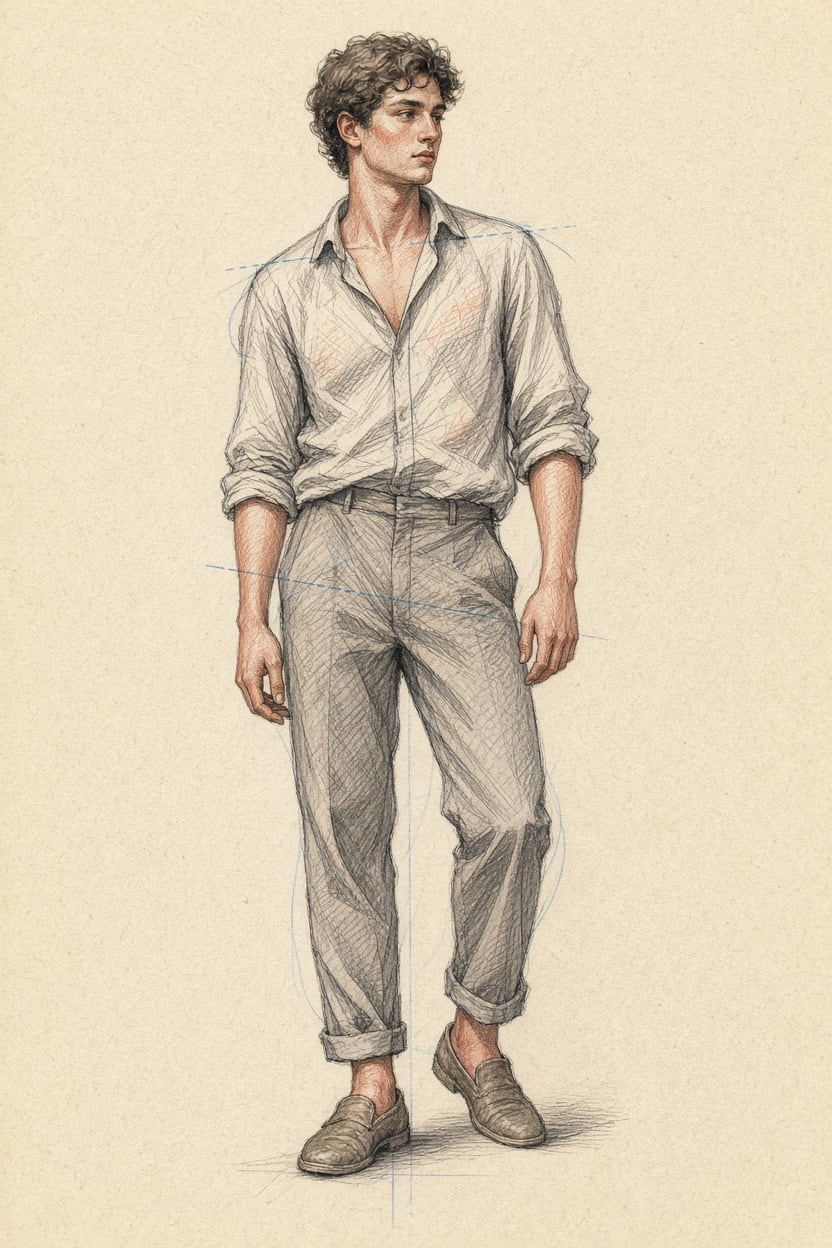
Standing leg and free leg
Hardly anyone stands evenly on both legs for long. Look around at a bus stop: most people shift their weight onto one leg and let the other relax. The leg that carries the load is the standing leg; the relaxed one is the free leg.
The standing leg is usually straight and almost vertical beneath the body. The free leg is slightly bent, its foot placed a little to the side or in front, sometimes resting only on the toes. If you work out which leg is carrying the weight before you draw, you've understood half the pose.
Contrapposto
As soon as the weight rests on one leg, the whole body changes. The hip on the standing-leg side pushes up and a little outwards. To keep from falling over, the shoulder line tilts the opposite way: on the standing-leg side the shoulder drops, on the other side it rises.
This opposing movement of shoulder line and hip line is called contrapposto. You already know the two axes from the stick figure; now you know why they tilt against each other. Draw the hip line at a slant and the shoulder line slanting the other way, and the figure immediately starts to stand rather than pose. Exaggerate the angle a little, or it gets lost in a small sketch.
The plumb line from the pit of the neck
Here's the most important tool in this lesson. Find the pit of the neck on the person, the small hollow at the base of the throat between the collarbones. Imagine a thread with a weight hanging straight down from there. On a standing person, this plumb line lands on the standing foot or, if the weight is shared between both legs, between the feet.
Draw the plumb line as a thin vertical before you put in the legs. Then place the standing foot exactly where the line meets the ground. If the plumb line lands outside the feet, your figure falls over, and anyone looking at it will sense this at once, even if they can't say why.
Sitting and leaning
It's not only standing people who have weight. Someone sitting passes the load to their buttocks and thighs, often to a backrest or to their elbows on the table as well. Draw the seat, even as a single line, and let the body visibly rest on it. The pelvis sinks a little, the back rounds, the shoulders drop forward.
Someone leaning against a wall stands at a slant. The plumb line from the pit of the neck no longer falls on the feet, because the wall is taking some of the weight. The point of contact, usually a shoulder or hip, is the most important spot in the pose. Draw it clearly.
Load and counterweight
People are almost always carrying something. With a heavy shopping bag in the right hand, the upper body leans left to compensate and the right shoulder is pulled down. Someone with a rucksack leans slightly forward. Someone pushing a pram leans their weight into the handle with arms straight, and the plumb line falls in front of the feet, because the pram is taking part of the load.
These balancing movements make your figures believable. Ask yourself with every person: what are they carrying, and how are they countering it?
Exercise
Find a place where people wait: a platform, a bus stop, a market stall, the queue at an ice-cream stand. Or use photos of people waiting. Draw six figures, 2 to 3 minutes each. For every figure, first drop the plumb line from the pit of the neck, decide which is the standing leg and set the shoulder and hip lines in contrapposto. At least one figure should be sitting or leaning, and at least one should be carrying or pushing something. Leave the plumb lines visible, photograph the page and show it to the coach.